He was a good optician, and he had owned his shop for many years. Most people in Galle knew him, his wife and their two children. The little optician’s shop was not far from Matara Road, close to the sea.
He had been waiting a long time for this customer, who had ordered his glasses the week before. Finding just the right pair had been difficult, and getting the prescription right had caused a few problems. But he was a good, loyal customer, and the optician would go to great lengths to make his friend happy. Whenever he visited, they would have Sri Lankan tea and ginger biscuits.
As they sat enjoying their tea and the comfortable silence between them, something extraordinary happened. Through the shop window, they could see the sea withdrawing. The bare seabed lay exposed beneath the hot sun. It was utterly strange, unlike anything they had ever seen or heard of. Several people ran out onto the exposed seabed to see where the sea had gone. Inside the little optician’s shop, the two men began laughing at this peculiar natural phenomenon.
But life can change in a nanosecond. The sea came rushing back with tremendous force, and water surged into the little shop. Both the optician and his good customer were lifted off their feet and swept into a wave filled with furniture, planks and everything else it had picked up. The man felt something hard strike the side of his head. Desperately, he reached for anything that might pull him free of Mother Nature’s powerful grip. His good customer drifted past him in the water, but the happy smile was gone from his eyes. They were empty and lifeless.
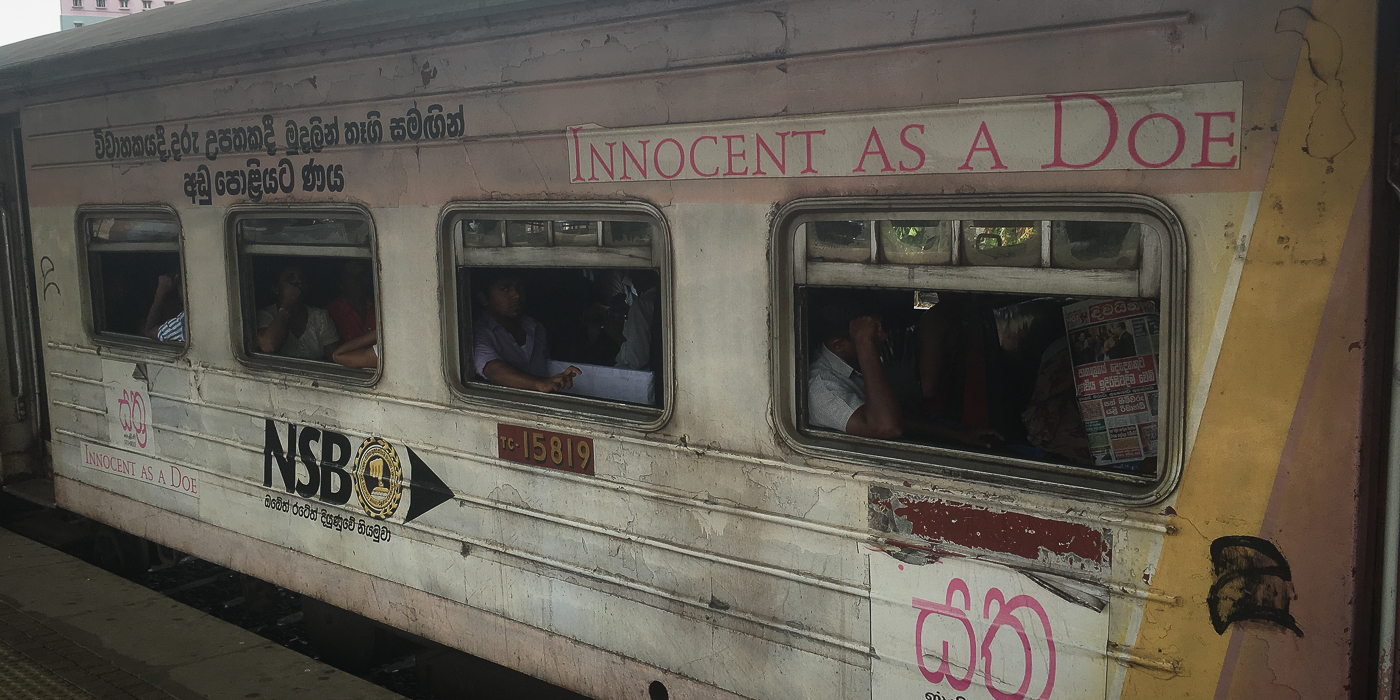
The train rattles along, rocking us from side to side.
By now we have taken this train journey many times, and we always travel third class with the locals. We are chatting with an elderly man of 77. His fingers are bent, his body somewhat hunched, and his skin is dark and weathered. He tells us how he was once a very good, well-respected optician, with a little shop in Galle. But after the tsunami, he lost everything. His body can no longer manage the work of an optician, and his shop was washed away. He survived, but his words also reveal a deep sorrow: he is the only one left. Mother Nature’s power took both his wife and his children.
It is hard not to be moved by the stories we hear from those left behind after the tsunami. They give you the deepest respect for the forces Mother Nature possesses.
We often strike up conversations with local people on the train from Weligama to Galle or Hikkaduwa. They are always very helpful if we are unsure which station comes next. We have made the journey many times now, because we have local friends in Galle and Danish friends holidaying in Hikkaduwa. Yet every time, I feel privileged to watch everyday local life passing by. From the train we see schoolchildren calling out, “Good morning, Ms Ella,” to their teacher as the school day begins; a woman doing the day’s washing and spreading it out on the roof to dry. We pass some very fine houses, but also very old ones dating back to the heyday of British rule. A monk smiles and gets off at Talpe Station. His orange robe makes a striking contrast with the dense green vegetation behind him. We have passed palms, shrubs and beautiful flowers, some of which we would normally only see as indoor pot plants in Denmark — and, of course, my favourite flower, the beautiful white frangipani.
“Thambili, thambili!” calls the man selling coconuts on the train. He sells large orange king coconuts, cutting off the top and putting in a straw so you can drink the coconut water. Soon another cry follows: “Surri, surri!” This seller has fried prawns pressed together with fried lentils. Christian and Sarah love them, but I am not entirely thrilled about eating prawns with their heads and little black eyes still attached.
A man with a disability walks through the train playing a little tune on his harmonica. Part of one arm is missing; only a short stump remains, which he uses to hold the harmonica to his mouth. People with disabilities receive no support from the government, and most of the beggars we see on the streets have disabilities. He recognises us and smiles. We always give this man some money.
For one stretch, the train runs very close to the sea, giving us a front-row view of the ocean. Let’s just hope the sea stays where it belongs.
It is very easy to take the train, which runs about eight times a day. You do need to keep an eye on the timetable at weekends, though. A third-class ticket to Galle costs 1.50 Danish kroner per person — twice that in second class. There is a little more room in second class, provided there are not too many tourists. But third class with the locals is more fun. They cannot quite understand why we do not simply take a tuk-tuk taxi. “Too expensive, we are long-term travellers,” we explain.
We pull into Galle. People rush aboard to get the best seats; queuing is certainly not something they practise here. It is simply a matter of getting there first. One man throws his bag through the window to reserve a seat opposite us — a clever trick.
Today we’re going to Hikkaduwa to visit our Danish friends. It’s also where we found snorkelling gear for Christian and Sarah. We later discovered that we could have bought it in Weligama too, and probably a little more cheaply. But we had another wonderful day with our good friends. Christian and Sarah got to try out their snorkelling gear and say hello to the fish and turtles.
We’ve taken the train many times, but on one occasion we had to catch the local bus from Galle to Weligama because we’d missed the train. It was the wildest experience. They drive like maniacs, and incredibly fast. I was reminded of the bus driver in the Harry Potter books, who calls out as the journey begins, “This is going to be a bumpy ride.” The bus rocked from side to side, with Sri Lankan music blaring at full volume. You have to be quick if you want to signal that you’d like to get off. In fact, all three of us were relieved when we finally stepped off the bus in Weligama, and we agreed that was one experience we didn’t need to repeat.
During our final week in Weligama, Sarah and I take the 9.55 am train to Galle every day. Sarah has been given a job at an art café, and I’m along as her little helper. The opportunity came about entirely by chance. One day, while wandering around Galle, we went into Café Serendipity, mainly because we needed to use the toilets. We struck up a conversation with the café’s owner. He showed us the first floor and told us about his dream of filling the space with art and making it cosy. On one side there’s a completely white wall, and on the opposite side are floor-to-ceiling windows. Both ends of the room are open to the outside, and one looks out towards the sea. Sarah immediately started suggesting what he could do and asking whether he’d considered this or that. She drew sketches and explained how he could fill the first floor with art, and he was quite taken with her ideas. They agreed that he would buy all the materials she needed and provide lunch each day.
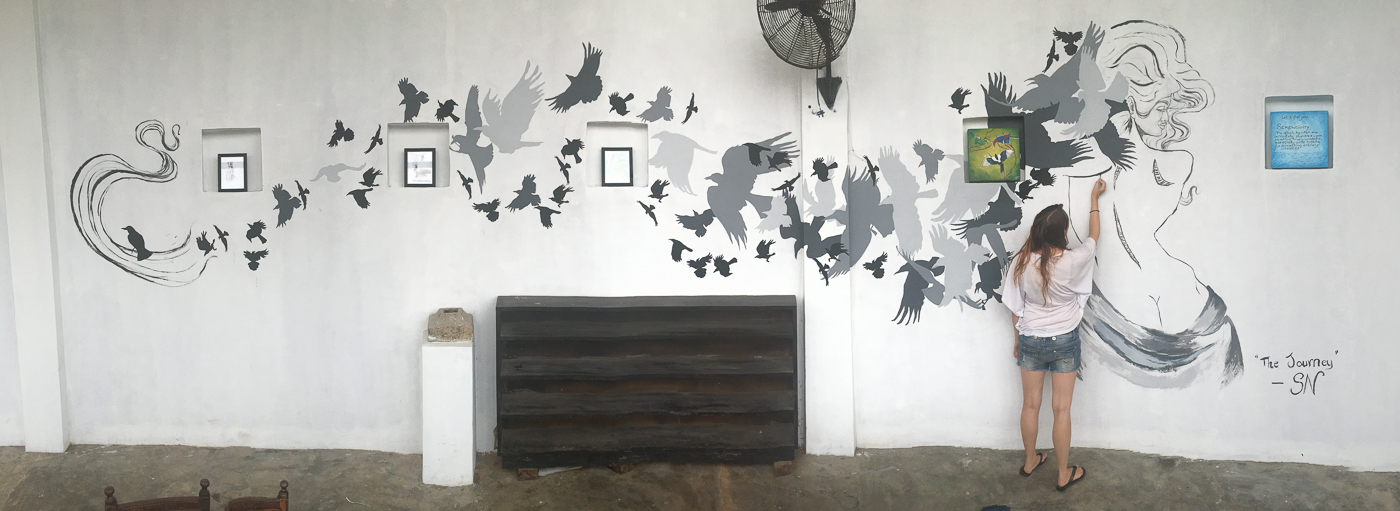
The finished artwork tells a very special story. First and foremost, the woman with birds in her hair represents a journey. The birds are crows, which have a particular significance for Galle and Sri Lanka. Half an hour before the tsunami struck, all the crows flew away from Galle, which is why Sarah painted them as crows. She also made three drawings in black frames and two canvas paintings. These reflect Sarah’s own personal journey. The drawing of the peacock woman was made on our first day in Sri Lanka and reflects the view from our first ‘home’. The drawing of the little puppy is, of course, Elly, her street dog, while the final drawing, featuring a four-legged bird, has become her personal trademark. The canvas painting with three crows is called ‘Past–Present–Future’. The black-and-white magpie from Denmark represents the past, the blue-and-red magpie from Sri Lanka represents the present, and the final magpie is from Cambodia and represents the future. The last canvas painting is Sarah’s interpretation of serendipity.
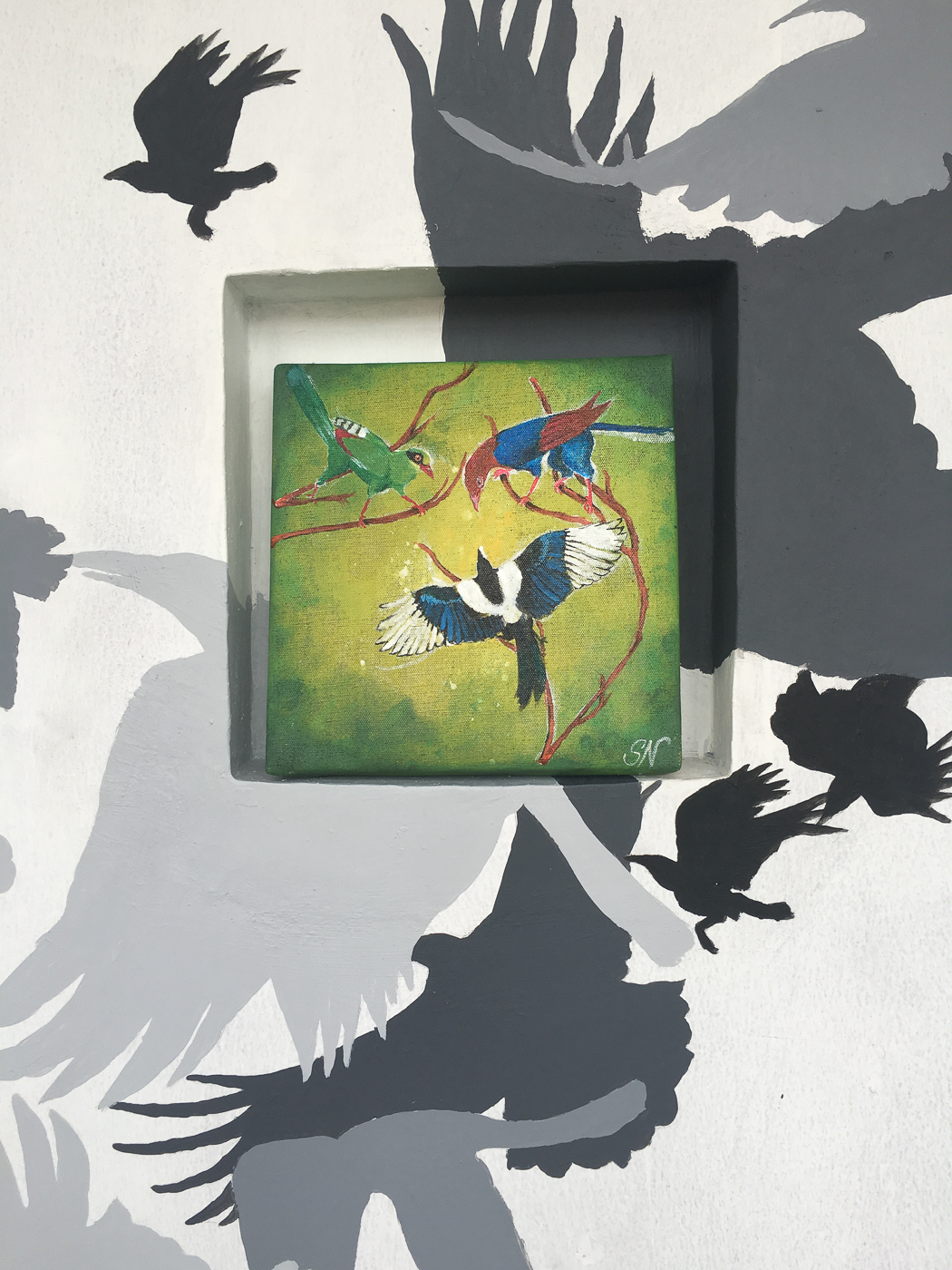
It was a wonderful assignment, although I suspect it’ll be a while before either Sarah or I paints another black bird. We had to paint every bird three times before the paint covered properly, so she’d certainly set herself quite a task. But she’s determined, and she’s working hard to build a portfolio of art projects for her application to study a Bachelor of Fine Art in Melbourne. And yes — both her parents are bursting with pride.
The project was completed, and we celebrated with the wonderful people at Serendipity Art Café.
The words are still echoing in our heads as we lie on the bed in our new home in Deniyaya, near the Sinharaja rainforest. The boys at Mansion Villa calling out ‘Amma!’ (Mum!), the fish seller in Weligama shouting ‘Malu, malu!’ (Fish!), the seller on the train calling ‘Surri, surri!’, and the music from last night’s farewell party.
We agree that none of us will say a word for the next 45 minutes. We need time to take it all in.
Saying goodbye to Weligama and Galle, where we’d spent a month, was really hard. The party with all the ‘boys’ from Serendipity Café was something special. We began with vodka and cranberry juice on the wall surrounding Galle Fort — the wall that once saved so many lives when the tsunami struck. Then the party continued on Unawatuna Beach with other locals and tourists.
Yes, we were a little tired the next day, when we still had to finish the Tetris-like task of packing our three backpacks. ‘Amma’ and ‘Thaththaa’, whom we’d lived with for a month, wanted to make us a farewell lunch, but we already had a lunch invitation. Our local tuk-tuk driver, Kasun, who’d been looking after us for the past couple of weeks, had invited us to his little home. Phew — his wife had cooked so much food! First we had king coconut milk, then rice and curry, which of course consists of lots of little dishes, followed by wood apple juice with plenty of sugar, and finally curd (fresh yoghurt) with treacle (palm syrup). We practically rolled out of the house and into his little tuk-tuk for our next stop: his parents’ home. There we met his entire family and were served ginger tea and home baking. Their hospitality and openness are beyond words. They own almost nothing, yet they invite us to a feast fit for royalty, offer us tea and coffee, and send us away with gifts in our hands. I wish everyone on this planet showed the same care, openness and hospitality.
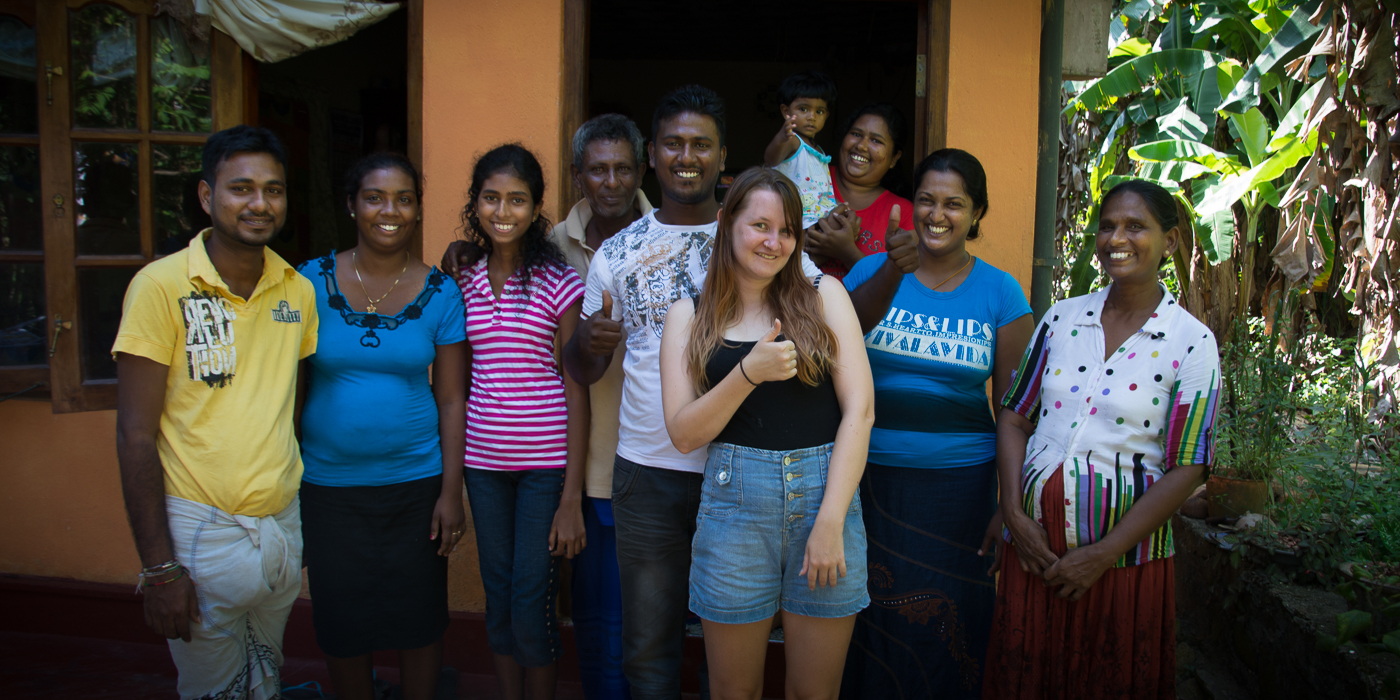
It was with a lump in our throats that we said goodbye to our wonderful family at the villa; our local shopkeeper, who’d invited us to lunch at his home; our local fisherman, who’d cooked the most delicious fish dishes and taken Christian to some wonderfully local sights; and, not least, our private tuk-tuk driver.
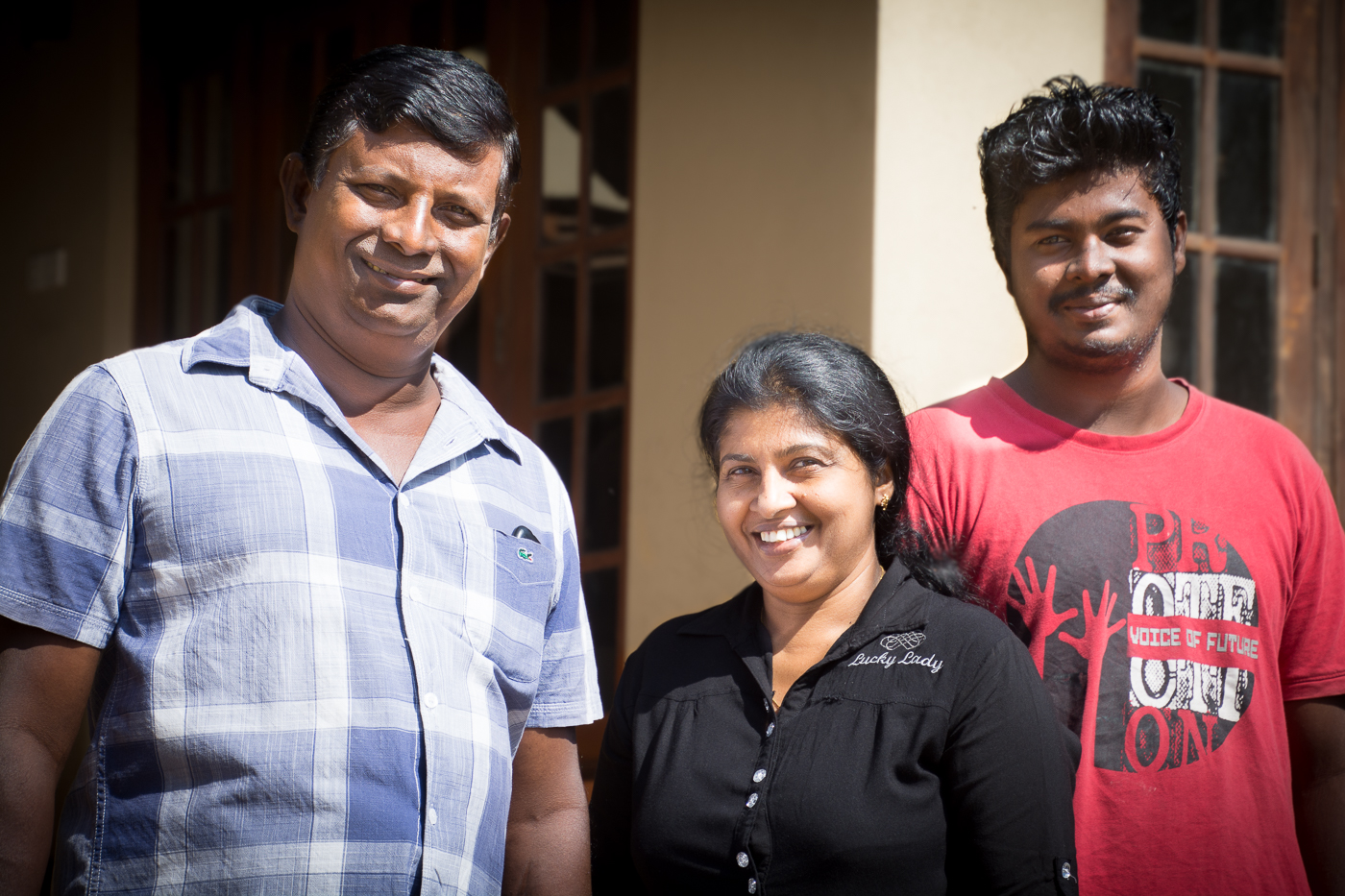
Our own personal serendipity has undoubtedly been the local people, who have completely won us over.
One thing is certain, though: Sarah will miss little Elly, the puppy she rescued from the street. She was a frail little thing, covered in ticks and lice and terribly thin. But Sarah took Elly to the vet to be vaccinated, fed her proper dog food every day and found her a new home.
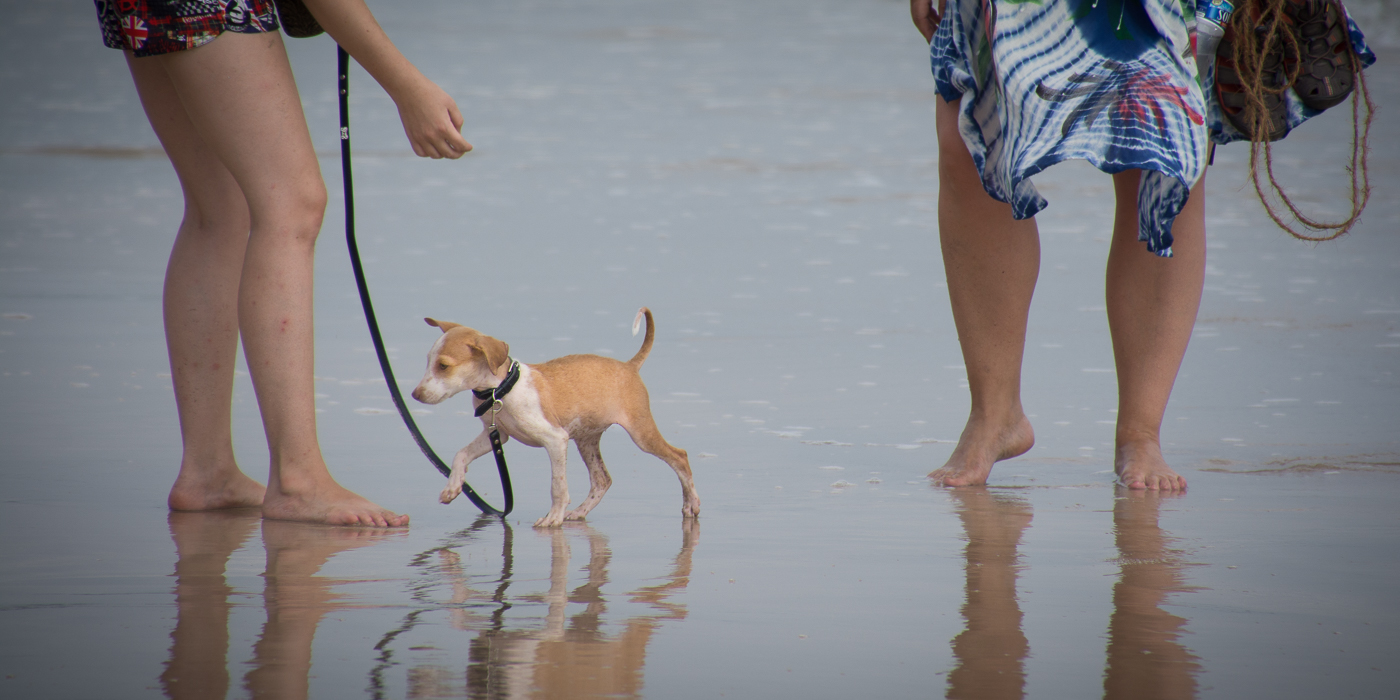
One of our last days, Elly got a collar and we took her down to the beach. She became a happy little dog, with a fresh start in life.
But our journey continues. We’ve planned three days in the Sinharaja rainforest, six days in Udawalawe and Yala national parks, and then quite a few days over on the east coast.
In five weeks we’ll be back in Colombo, where Sarah has a volunteer position with Embark, an organisation that helps street dogs in Sri Lanka.
But as I sit here writing this newsletter in our new home, a message arrives from life back in Denmark. For a moment, everything stands still. A comforting breeze brushes gently against my cheek, as though trying to catch what is coming. My sister writes that she is experiencing what every parent fears, and what no parent should ever have to endure. Her son passed away during the night after a long illness. Although we all knew that his disability meant we could lose him at any moment, it is never something you can accept when a life is taken away. For a moment, we turn to spiritual thoughts and believe that someone will be there to welcome him on the other side.
Today is a special day for Buddhists in Sri Lanka. There was a full moon last night, when my nephew gave his soul to the universe. His extraordinary strength, happy smile and fighting spirit will remain in our thoughts forever.
Life is only a nanosecond of eternity — remember to kiss the people you love and live today as though it were your last.